
Christmas at St. Louis Program

Concert Program
The Orchestra of St. Louis
The St. Louis Concert Chorus
Terry Eberhardt, conductor
The St. Louis Treble Choir
Paul Heinemann, conductor
Part 1
To read the program notes, simply press the + button next to each name.
-
arr. Benjamin Harlan
The triumphant “Processional for Christmas” is anchored by “O, Come All Ye Faithful,” which summons people everywhere to come to Bethlehem to adore—in the truest sense of prayer and worship—the “King of Angels.” The call to prayer is the central idea of this beloved hymn, which welcomes the faithful and invites them to observe the great feast of the nativity.
Though its Latin title, Adeste Fideles, suggests ancient origins, the carol is relatively modern. For centuries its authorship was uncertain, attributed variously to a medieval monk, Saint Bonaventure, and even a Portuguese lyricist. Only in the mid-20th century was the true author identified as John Francis Wade (1711–1786), an English Catholic priest, musician, and professional calligrapher who fled to France in 1745 during England’s period of religious persecution. Settled in France, Wade devoted himself to preserving and disseminating sacred music to Catholic churches throughout Europe.
Wade was also inspired to write new hymns. As a Catholic cleric, it was only natural that he composed his works in Latin. Wade first published “Adeste Fideles” in 1751, adding lyrics a decade later. It would become his most famous hymn, with translations in more than 150 languages and hundreds of recordings.
Tonight’s “Processional for Christmas” is an arrangement by Benjamin Harlan, who currently serves as Dean of the School of Church Music at Southwestern Baptist Theological Seminary (SBTS) in Fort Worth, Texas. Harlan is internationally recognized for his work as a composer and arranger, with contributions spanning choral, keyboard, handbell, and congregational music.
-
by Ralph Vaughan Williams
arr. Ralph GreavesRalph Vaughan Williams’s Fantasia on Greensleeves is a brief orchestral miniature that evokes serene pastoral landscapes, timelessness, and quiet mystery. The composer originally used the piece in Act III of his 1928 opera Sir John in Love, an adaptation of Shakespeare’s The Merry Wives of Windsor.
The Fantasia we know today draws not only on the traditional English folk melody “Greensleeves” alluded to in its title, but also on the folk tune “Lovely Joan,” which Vaughan Williams collected in Suffolk. In 1934, with assistance from arranger Ralph Greaves, the composer transformed the opera excerpt into the orchestral version that remains one of his most beloved works.
The tune “Greensleeves” itself dates to the late 16th century, first appearing in a 1580s songbook under the title “A Newe Northen Dittye of ye Ladye Greene Sleves.” Its popularity spread rapidly—numerous variants appeared within a year, and Shakespeare referenced the melody in The Merry Wives of Windsor (1597). In the Victorian era, the 1865 poem What Child Is This? by William Chatterton Dix was set to the Greensleeves tune, giving the old folk melody new life as a beloved Christmas carol.
EXTRA CREDIT READING
Ralph Vaughan Williams (1872–1958) was a versatile and forward-looking composer whose works range from intimate songs and hymn tunes to grand symphonies, operas, and ballets. Deeply influenced by English folk song and the choral traditions of the Tudor period (1485–1603), he helped steer British music away from the German-dominated style of the 19th century toward a distinctly national voice.
From his earliest years, Vaughan Williams immersed himself in the folk traditions of rural England, traveling through the countryside to collect hundreds of songs directly from village singers. He joined the newly founded English Folk Song Society in 1904, which was to exert great influence on his music. Vaughan Williams’s music came to epitomize the English pastoral school, a movement that drew its inspiration from folk melodies and the English countryside. Fantasia on Greensleeves illustrates how Vaughan Williams blended English folk melodies with his characteristic pastoral style.
-
by Noel Regney and Gloria Shayne
arr. Jay DauschBy the late 1950s and early 1960s, Noël Regney and Gloria Shayne had established themselves as a successful songwriting duo, with their pop hits recorded by stars like Doris Day, Eddie Fisher, and Bobby Vinton. Yet it was their carol “Do You Hear What I Hear?”—written during the tense days of the Cuban Missile Crisis in October 1962—that became their enduring legacy.
For this song, the husband-and-wife team reversed their usual creative roles: Regney, typically the composer, penned the lyrics, while Shayne composed the melody. Together, they created a musical plea for peace at a moment when the threat of nuclear war felt alarmingly real.
The song’s message resonated instantly. Shortly after Thanksgiving 1962, the Harry Simeone Chorale released the first recording, selling more than 250,000 copies in its first week. The following year, Bing Crosby’s rendition became a runaway success, selling over a million copies and firmly establishing the song as a new holiday standard. Since then, “Do You Hear What I Hear?” has been performed by countless artists, its message of peace and goodwill continuing to ring true decades later.
-
by Franz Schubert
Colleen Daly, soprano
-
by George Frideric Handel
Alexandra Christoforakis, alto
Handel’s Messiah—composed in 1741 and premiered in 1742—has become a beloved Christmas tradition, celebrated for its profound musical storytelling. The aria “But Who May Abide the Day of His Coming,” from Part I of the oratorio, draws its text from the Old Testament prophet Malachi. It poses the question: Who can endure the arrival of the Messiah, “for He is like a refiner’s fire”? Handel’s setting brings these words to life, pairing an introduction that evokes anticipation and reverence with a dramatic section that portrays the force of the Messiah’s coming.
John Rutter Carols
What would the Christmas season be without the carols of John Rutter? One of England’s most celebrated composers and choral conductors, Rutter has written an extensive body of work that spans hymn settings, orchestral and instrumental pieces, and larger choral masterworks such as the Gloria and Requiem. He has also contributed as an editor, co-editing the beloved Carols for Choirs series and curating the Oxford Choral Classics anthologies.
Yet it is through his Christmas carols that Rutter has most deeply touched audiences around the world. From his earliest works composed as a teenager—"Nativity Carol” and “Shepherd’s Pipe Carol”—to the nearly two dozen that followed, John Rutter has created a musical legacy that narrates, reflects upon, and celebrates the Christmas story.
Tonight’s program features six of Rutter’s original carols, each capturing in its own way the joy, wonder, and hope of the season. The following selections highlight the composer’s gift for melody and his enduring contribution to the Christmas choral tradition.
To read the lyrics for the John Rutter Carols, simply press the + button next to each carol name.
-
by John Rutter
Rutter composed “Angel’s Carol” in 1987 for a now-defunct choirboy and choirgirl competition in London. Conceived as a celebratory piece for the competition’s young winners, it was originally written in a simple two-part form, and shortly thereafter arranged for mixed choir. Oxford University Press published the work in 1988. Rutter also wrote the text, crafting three verses that retell the Nativity story, interwoven with the exultant “Gloria in excelsis Deo” refrain. First recorded by The Cambridge Singers in 2001, “Angel’s Carol” has since become one of Rutter’s most beloved and frequently performed Christmas works.
LYRICS
Have you heard the sound of the angel voices
Ringing out so sweetly, ringing out so clear?
Have you seen the star shining out so brightly
As a sign from God that Christ the Lord is here?Have you heard the news that they bring from heaven
To the humble shepherds who have waited long?
Gloria in excelsis Deo! Gloria in excelsis Deo!
Hear the angels sing their joyful songHe is come in peace in the winter's stillness
Like a gentle snowfall in the gentle night
He is come in joy, like the sun at morning
Filling all the world with radiance and with lightHe's come in love as the child of Mary
In a simple stable, we have seen his birth
Gloria in excelsis Deo! Gloria in excelsis Deo!
Hear the angels singing 'Peace on earth'He will bring new light to a world in darkness
Like a bright star shining in the skies above
He will bring new hope to the waiting nations
When he comes to reign in purity and loveLet the earth rejoice at the Saviour's coming
Let the heavens answer with a joyful morn
Gloria in excelsis Deo! Gloria in excelsis Deo!
Hear the angels singing, "Christ is born"
Hear the angels singing, "Christ is born" -
by John Rutter
Written in 1963 when Rutter was still in his teens, “Nativity Carol” stands among the composer’s earliest works. Rutter himself authored the text, creating a simple, poetic retelling of the Nativity, from the humble stable and shining star to the adoration of the Christ Child. Since its publication by Oxford University Press nearly six decades ago, “Nativity Carol” has been embraced by choirs worldwide, earning a place in the modern Christmas repertoire.
LYRICS
Born in a stable so bare
Born so long ago
Born 'neath light of star
He who loved us soFar away, silent he lay
Born today, your homage pay
For Christ is born for aye
Born on Christmas DayCradled by mother so fair
Tender her lullaby
Over her son so dear
Angel hosts fill the skyFar away, silent he lay
Born today, your homage pay
For Christ is born for aye
Born on Christmas DayWise men from distant far land
Sheperds from starry hills
Worship this babe so rare
Hearts with his warmth he fillsFar away, silent he lay
Born today, your homage pay
For Christ is born for aye
Born on Christmas DayLove in that stable was born
Into our hearts to flow
Innocent dreaming babe
Make me thy love to knowFar away, silent he lay
Born today, your homage pay
For Christ is born for aye
Born on Christmas Day... -
by John Rutter
In 1971Sir David Willcocks—the legendary conductor and co-editor of the Carols for Choirs anthologies—invited Rutter to compose a new carol for The Bach Choir’s annual Christmas concert at London’s Royal Albert Hall. The concert, a beloved seasonal highlight, traditionally includes a segment where children from the audience are invited to join the choir onstage. Willcocks requested a piece with an easy, memorable refrain that could be quickly taught to the children. In response, Rutter delivered “Star Carol,” a joyful work that has since become one of his most popular and enduring carols.
LYRICS
Sing this night (for a boy is born in Bethlehem)
Christ our Lord (in a lowly manger lies)
Bring your gifts (come and worship at his cradle)
Hurry to Bethlehem and see the son of MarySee his star shining bright
In the sky this Christmas night
Follow me joyfully
Hurry to Bethlehem and see the son of MaryAngels bright (come from heaven's highest glory)
Bear the news (with its message of good cheer)
Sing, rejoice (for a King is come to save us)
Hurry to Bethlehem and see the son of MarySee his star shining bright
In the sky this Christmas night
Follow me joyfully
Hurry to Bethlehem and see the son of MarySee, he lies in his mother's tender keeping
Jesus Christ in her loving arms asleep
Shepherds poor, come to worship and adore him
Offer their humble gifts before the son of MarySee his star shining bright
In the sky this Christmas night
Follow me joyfully
Hurry to Bethlehem and see the son of MaryLet us pay our homage at the manger
Sing his praise on this joyful Christmas Night
Christ is come, bringing promises of salvation
Hurry to Bethlehem and see the son of MarySee his star shining bright
In the sky this Christmas night
Follow me joyfully
Hurry to Bethlehem and see the son of Mary
Hurry to Bethlehem and see the son of Mary -
by John Rutter
Rutter wrote “Candlelight Carol” in 1984 in response to a commission from a Catholic church in Pittsburgh, Pennsylvania that had requested a simple, singable carol for its congregation. Rutter’s setting evokes the tender image of Mary cradling the infant Jesus by the glow of candles. The piece was first recorded by Rutter's own ensemble, the Cambridge Singers, on their 1987 album Christmas Night.
LYRICS
How do you capture the wind on the water?
How do you count all the stars in the sky?
How can you measure the love of a mother?
Or how can you write down a baby's first cry?Candlelight, angel light, firelight and star-glow
Shine on his cradle 'til breaking of dawn
Gloria, gloria in excelsis Deo!
Angels are singing "The Christ child is born"Shepherds and wise men will kneel and adore him
Seraphim 'round him, their vigil will keep
Nations proclaim him their Lord and their saviour
But Mary will hold him and sing him to sleepCandlelight, angel light, firelight and star-glow
Shine on his cradle 'til breaking of dawn
Gloria, gloria in excelsis Deo!
Angels are singing "The Christ child is born"Find him in Bethlehem laid in a manger
Christ our redeemer, asleep in the hay
Godhead incarnate and hope of salvation
A child with his mother that first Christmas DayCandlelight, angel light, firelight and star-glow
Shine on his cradle 'til breaking of dawn
Gloria, gloria in excelsis Deo!
Angels are singing "The Christ child is born" -
by John Rutter
Composed around 1965, “Shepherd’s Pipe Carol” was an early triumph and Rutter’s first published work. Written for a concert at Clare College, Cambridge, the carol tells of a young shepherd boy joyfully piping on his way to Bethlehem to see the Christ child. Rutter’s inspiration came in part from his own experience as a boy soprano in the opera Amahl and the Night Visitors, where he was captivated by the sound of the shepherd’s pipe as Amahl sets out for Bethlehem.
LYRICS
Going through the hills on a night all starry
On the way to Bethlehem
Far away I heard a shepherd boy piping
On the way to BethlehemAngels in the sky brought this message nigh:
"Dance and sing for joy that Christ the newborn King
Is come to bring us peace on earth
And He's lying cradled there at Bethlehem.""Tell me, shepherd boy piping tunes so merrily
On the way to Bethlehem
Who will hear your tunes on these hills so lonely
On the way to Bethlehem?Angels in the sky brought this message nigh:
"Dance and sing for the joy that Christ the newborn King
Is come to bring peace on earth
And He's lying cradled there at Bethlehem.""None may hear my pipes on these hills so lonely
On the way to Bethlehem;
But a King will hear me play sweet lullabies
When I get to Bethlehem."Angels in the sky came down from on high
Hovered over the manger where the babe was lying
Cradled in the arms of his mother Mary
Sleeping now at Bethlehem -
by John Rutter
In 1987, Rutter received a special commission from the famed King’s College Chapel in Cambridge: compose a piece for the Christmas Eve “Festival of Nine Lessons and Carols”. Rutter set to music a 17th century verse by Robert Herrick “What sweeter music can we bring than a carol for to sing the birth of this our heavenly King?” The carol became an instant classic, reaching an even wider audience in the 1990s when it was featured in a Volvo commercial.
LYRICS
What sweeter music can we bring
Than a carol for to sing
The birth of this our Heavenly King?
Awake the voice, awake the stringDark and dull night, fly hence away
And give the honor to this day
That sees December turned to May
That sees December turned to MayWhy does the chilling winter's mourn
Smile, like a field beset with corn?
Or smell like a meadow newly-shorn
Thus, on the sudden? Come and see
The 'cause, why things thus fragrant be
It is He is born, whose quickening birth
Gives life and luster, public mirth
To Heaven, and the under-EarthWe see him come, and know him ours
Who with his sunshine and his showers
Turns all the patient ground to flowers
Turns all the patient ground to flowersThe darling of the world is come
And fit it is, we find a room
To welcome him, to welcome him
The nobler part of all the house here is the heartWhich we will give him, and bequeath
This holy and this ivy wreath
To do him honour, who's our King
And Lord of all this revellingWhat sweeter music can we bring
Than a carol for to sing
The birth of this our Heavenly King?
Of this our Heavenly King, our King -
by Adolphe Adam
arr. John RutterThe origins of “O Holy Night” involve a local priest, the talents of a poet and wine merchant, and a Jewish composer in a small French town. Years later, unrelated actions by two Americans would bring the song and its powerful, awe-inspiring imagery to the attention of those on the other side of the Atlantic Ocean, helping make it one of the world’s most beloved carols.
"O Holy Night" began its life in 1847 in Roquemaure, France. A parish priest asked local poet Placide Cappeau to write a new Christmas poem to mark church renovations (some sources note that it was the organ, while others, restoration of the stained glass windows). Cappeau agreed and soon penned “Minuit, chrétiens” (“Midnight, Christians”). He then turned to his friend, composer Adolphe Charles Adams to set the poem to music. The resulting song, Cantique de Noël, was first performed at Midnight Mass on Christmas Eve 1847, quickly becoming a favorite throughout France.
Across the Atlantic, the carol caught the attention of Unitarian minister and music critic John Sullivan Dwight. Moved by its messages of awe, peace, and human dignity, Dwight authored and in 1855 published an English adaptation in his Dwight’s Journal of Music, renaming it “O Holy Night.” Dwight’s version resonated deeply with American audiences, particularly for its lines proclaiming, “Chains shall He break, for the slave is our brother,” which spoke powerfully to a nation increasingly divided over slavery. By the late nineteenth century, O Holy Night had become a Christmas tradition in the United States.
Nearly two centuries after its debut, the powerful imagery and emotional melody of “O Holy Night” have inspired countless artists and listeners, making it a favorite across cultures and generations. The song’s messages—inviting us to “fall on our knees” and reflect on the holy night of Christ’s birth—make it a staple in Christmas worship services and concerts traditions worldwide.
EXTRA CREDIT READING
The carol’s history includes several notable, though undocumented, moments. On Christmas Eve 1906, Reginald Fessenden, a Canadian-born electrical engineer and protégé of Thomas Edison, made what is believed to be the first radio broadcast in history—reading from the Gospel of Luke and playing “O Holy Night” on his violin for listeners aboard ships in the North Atlantic. Another story recounts that during the Franco-Prussian War in 1870, a French soldier began singing Cantique de Noël from the trenches, prompting a brief Christmas truce as soldiers on both sides paused to listen.
LYRICS
O holy night, the stars are brightly shining
It is the night of the dear Saviour's birth
Long lay the world in sin and error pining
Till He appeared
And the soul felt its worthThe thrill of hope, the weary world rejoices
For yonder breaks a new and glorious mornFall on your knees
Oh hear the angel voices
O night divine
O night when Christ was born
O night divine
O night, O night divineTruly He taught us to love one another
His law is love and His gospel is peace
Chains shall He break for the slave is our brother
And in His name
All oppression shall ceaseSweet hymns of joy in grateful chorus raise we
Let all within us praise His holy nameChrist is the Lord
Oh praise His name forever
His power and glory
Evermore evermore proclaim
His power and glory
Evermore evermore proclaim
10 Minute Intermission
Part 2
-
by Leroy Anderson
The seasonal favorite “Sleigh Ride,” instantly recognizable for its upbeat melody, jingling sleigh bells, clip-clops, and horse whinny, traces its origins to a heat wave and drought in Connecticut during the summer of 1946. After his release from active duty in the U.S. Army, Leroy Anderson was staying with his family in a cottage in Woodbury, where he began composing several new pieces. To take his mind off the oppressive heat, Anderson sketched a tune that captured the fun of a winter sleigh ride. He completed the orchestral score in February 1948, after moving to Brooklyn, New York, appropriately finishing it following one of the city’s snowiest winters on record.
“Sleigh Ride” was premiered on May 4, 1948, at Boston’s Symphony Hall by the Boston Pops Orchestra under the baton of Arthur Fiedler. It quickly became a Pops signature piece, and their 1949 recording turned it into a nationwide hit. In 1950, Mitchell Parish, a Jewish immigrant from Lithuania, added lyrics to the tune.
Although the words make no mention of Christmas or the holiday season, “Sleigh Ride” soon became a Christmastime favorite. More than 75 years after it was written, it remains a staple of holiday programming for orchestras and artists worldwide and continues to rank among the top 10 most popular Christmas songs internationally.
EXTRA CREDIT READING
Leroy Anderson, the unrivaled master of light orchestral pieces, was also a talented linguist, fluent in nine languages. Born to Swedish immigrants in 1908, Anderson studied toward a Ph.D. degree in German and Scandinavian at Harvard University while working as a music tutor at Radcliffe College. His language proficiency earned him a U.S. Army assignment to Iceland during World War II, where he wrote an Icelandic grammar book for the army. In 1945, Anderson was sent to the Pentagon as chief of the Scandinavian Desk of Military Intelligence. He declined an offer to serve as U.S. military attaché to Sweden, finally deciding to make composing his full-time profession. Anderson died in 1975, but his musical legacy lives on every holiday season.
-
by Jerry Herman
arr. Mark Hayes“We Need a Little Christmas” originated in the 1966 Broadway musical Mame. In the story, Auntie Mame has just lost her fortune in the 1929 stock market crash, leaving her no way to provide for her self-made family, young nephew Patrick and two household servants. The eternally optimistic Mame declares that her household “needs a little Christmas, right this very minute,” even though it hasn’t yet snowed a single flurry. She hauls out the holly and decorates early to cheer up her nephew and staff, embodying the musical’s optimistic spirit in the face of the Great Depression.
Although written for musical theater, “We Need a Little Christmas” quickly took on a life beyond the stage, with the Percy Faith orchestra and The New Christy Minstrels recording it within a year of its debut. Since then, generations of performers have added their own interpretations.
Tonight’s performance features Mark Hayes’s choral arrangement, which brings fresh sparkle to this Broadway favorite, while preserving the melody and optimistic message of Jerry Herman’s classic. Mark Hayes is a renowned American composer and arranger known for his choral settings across both sacred and secular music.
As we perform this number, we are reminded that sometimes we all “need a little Christmas” in our lives to lift our hearts.
-
by Harold Rome
arr. Jay Dausch“Be Kind to Your Parents,” a song that celebrates the ups and downs of the parent-child relationship, first appeared in the 1954 Broadway musical Fanny, composed by Harod Rome. Although this lesser-known musical proved to be a box office success—running for 888 performances on Broadway and later staged in the West End—“Be Kind to Your Parents” is the only song from the show that found lasting popularity beyond the stage.
Folk music icon and activist Pete Seeger introduced the song to a wider audience in 1963 by including it on the album Children’s Concert at Town Hall.
Holiday Roundtable
Colleen Daly, soprano
Erin Wegner Brooks, soprano
Joe Ciani-Daush, tenor
-
arr. Jay Dausch
First released in 1954, “There’s No Place Like Home for the Holidays” quickly became one of America’s most cherished Christmas songs. With music by Robert Allen and lyrics by Al Stillman, its warm, singable melody and heartfelt lyrics helped establish it as a staple of the holiday repertoire.
“Home for the Holidays” emerged in the post-World War II era, a period marked by growing prosperity, cross-country travel, and new highways. The song’s imagery—families reuniting, loved ones traveling great distances to be together—captured not only the optimism of the time, but also the importance of being home after years of separation and sacrifice. Though its lyrics reflect mid-20th-century American culture (with nods to Pennsylvania, Tennessee, Mississippi and homemade pumpkin pie), its core message of togetherness and Christmas as a time for homecoming continues to resonate across generations.
Perry Como introduced the song to the public with a recording that became an immediate hit, reaching the Top 20 on Billboard’s charts during the 1954 holiday season. Its theme of homecoming struck a chord with listeners then—as it still does today. Over the decades, countless artists have recorded their own renditions, and the song has appeared in television specials, holiday films, and seasonal advertising. Such lasting popularity speaks to the timeless appeal of its message – no matter how far we roam or how much life changes, the comfort of home and presence of family remains at the center of the holiday spirit.
-
arr. Jay Dausch
Written by Hugh Martin and Ralph Blane for the 1944 film Meet Me in St. Louis, “Have Yourself a Merry Little Christmas” quickly became a cherished holiday classic. The song was first performed by Judy Garland in the film’s memorable Christmas Eve scene, where her character Esther Smith comforts her younger sister who is distraught over the family’s plans to relocate from St. Louis to New York. When the song was first written, its lyrics were overly melancholic, and Garland refused to sing them. After some persuasion from Garland and her co-star Tom Drake, Martin agreed to soften them, shifting the tone to one of reassurance and hope. The lyrics’ promise of comfort and brighter days ahead deeply resonated with audiences longing for peace and togetherness during World War II.
Generations of musicians representing every genre—from Frank Sinatra and Ella Fitzgerald to more modern artists—have reimagined the song. Today, its gentle melody and message of hope have made it a timeless Christmas classic, cherished by generations.
EXTRA CREDIT READING #1
A little over a decade after “Have Yourself a Merry Little Christmas” first debuted, Frank Sinatra approached Hugh Martin with a special request. Sinatra wished to feature the song on his new holiday album, A Jolly Christmas, but deemed the lyrics from the movie to be too dark. At Sinatra’s urging, Martin revised the song once again. The most notable change was replacing “Until then we’ll have to muddle through somehow” with the more festive “Hang a shining star upon the highest bough.” Martin also adjusted a few other lines, such as changing “Faithful friends who were dear to us will be near to us once more” to “Faithful friends who are dear to us gather near to us once more,” shifting the focus to celebrating the present rather than anticipating the future. Sinatra’s popular 1957 recording cemented the song’s status as a Christmas classic, and many later artists adopted his “shining star” lyric as the new standard.
EXTRA CREDIT READING #2
“Have Yourself a Merry Little Christmas” was far from the biggest hit when Meet Me in St. Louis premiered in 1944. Audiences who filled theaters that winter were captivated by a string of instantly memorable songs sung by Judy Garland, including the “The Trolley Song” and “The Boy Next Door,” both of which became immediate hits. At the time, these lively tunes overshadowed the quieter, more reflective Christmas number. Over the decades, however, it was “Have Yourself a Merry Little Christmas” that proved timeless. Its message of gentle resilience and hope has made it one of the most beloved and enduring holiday songs, returning to radio stations, streaming services, and concert stages year after year.
-
arr. Jay Dausch
It took 45 minutes to write the song. It takes a little more than three minutes to sing it. If you’re curious about an activity you’ll likely never attempt, it takes about 15 minutes to roast chestnuts on an open fire. Those are just a few measures of time for “The Christmas Song,” a Yuletide classic with truly timeless appeal.
Written in 1945 by pianist-singer Mel Tormé and lyricist Bob Wells, “The Christmas Song” distills the sentimental imagery of a Norman Rockwell Christmas—firelight, carols, and cold noses—in just a few nostalgic phrases. It was born, ironically, on a scorching July day in California. Hoping to cool off by immersing himself in thoughts of cold winters, Wells had jotted a few lines on a notepad: “Chestnuts roasting… Jack Frost nipping… Yuletide carols… Folks dressed up like Eskimos.” When Tormé saw them, the two set aside their planned project and within 45 minutes had written what would become one of the most enduring songs of the season.
That same day, they played it for Nat King Cole, who immediately recognized its charm and asked to record it before anyone else could. Cole went on to record the song four times. His 1961 version, featuring a more sophisticated orchestration than previous recordings, remains the definitive interpretation heard on radio stations and streaming services every December. The original 1946 Nat King Cole Trio recording was inducted into the Grammy Hall of Fame in 1974, securing its place among America’s most beloved holiday standards.
EXTRA CREDIT READING
Nat King Cole’s “The Christmas Song” holds a special place in American music history as the first major Christmas standard introduced by a Black musician. Cole was also a trailblazer far beyond the recording studio. In 1946, his radio program King Cole Trio Time became the first network radio series sponsored by a Black artist. In 1956 he broke further ground as the first Black performer to host a weekly television show. Though the program drew strong ratings and reviews, it ended after 64 weeks due to a lack of national advertising support. Cole’s legacy, however, endures: his smooth voice and dignified artistry transformed “The Christmas Song” into a symbol of both holiday warmth and cultural breakthrough.
-
arr. Jay Dausch
“What Are You Doing New Year’s Eve?” may seem like a question best asked in mid-to-late December, but that wasn’t Frank Loesser’s intention when he wrote the song in 1947. Although the tune is now closely associated with the holiday season, Loesser’s lyrics—referring to “the jackpot question in advance”—suggest the inquiry is made well before December. In fact, Loesser was reportedly frustrated when the song was performed during the holidays, as he had envisioned it about making a long-term commitment far in advance, which he felt made more sense when sung in another season.
Nonetheless, it didn’t take long before listeners were embracing Loesser’s song as a romantic New Year’s standard. In December 1947, singer Margaret Whiting introduced “What Are You Doing New Year’s Eve?”—adding a hint of “Auld Lang Syne” at the end. Though Whiting’s recording wasn’t a major hit, the song gained popularity through radio play and sheet-music sales. It first charted in 1949 with The Orioles’ Top-10 rhythm-and-blues version, and by the 1960s it was firmly established as part of the holiday canon.
-
arr. Jay Dausch
The yuletide classic “That Holiday Feeling” was launched in 1964 by husband-and-wife duo Steve Lawrence and Eydie Gorme as the title song of the couple’s Christmas album. Written by Lawrence, Gorme, and other collaborators, the upbeat number was one of two originals on that album (alongside “Let Me Be the First to Wish You Merry Christmas”) amid a collection of familiar Yuletide favorites.
Nearly six decades later, actors and vocalists Seth MacFarlane and Liz Gillies reprised “That Holiday Feeling” on their 2023 Christmas album We Wish You The Merriest.
-
by Irving Berlin
Erin Wegner Brooks, soprano
Joe Ciani-Dausch, tenorFew American songwriters were as prolific as Irving Berlin. In a career spanning decades he wrote well over 1,500 songs, including “God Bless America” and scores of Broadway and Hollywood hits. Similarly, Harry Lillis “Bing” Crosby became one of the most successful entertainers in U.S. history, selling millions of records and appearing in more than 100 films. Berlin’s patriotic anthem aside, it is one holiday song--“White Christmas”—that is most closely associated with both men, serving as Crosby’s signature tune and one of Berlin’s most celebrated compositions.
Bing Crosby first introduced “White Christmas” on his radio show on December 25, 1941, just three weeks after the attack on Pearl Harbor. When the song was released as a single in the unlikely month of August 1942, and featured in the film Holiday Inn that same year, World War II was fully underway. Millions of servicemen and women were stationed in warm, snowless regions around the globe, often in places where Christmas was not celebrated at all. The song’s lyrics, expressing a longing for Christmases “just like the ones I used to know,” deeply resonated with listeners—especially those far from home. “White Christmas” went on to win the Academy Award for Best Song in 1942.
Building on the success of Holiday Inn, Paramount Pictures set out to create another movie musical, this time centered around the most beloved Christmas pop song of all time. In 1954, White Christmas premiered on the big screen and quickly became a holiday classic. Decades later, in the 2000s, the film was adapted for the Broadway stage, following successful previews in several U.S. cities and the United Kingdom.
Today, “White Christmas” stands as the ultimate holiday classic. With the possible exception of “Silent Night,” no other song is more closely associated with the Christmas season. It has been recorded by hundreds of artists, with over 500 versions noted. The version of “White Christmas” we are performing tonight was introduced in 1954 during the doo-wop era by The Drifters, becoming an instant hit. This distinctive arrangement was later reprised by Michael Bublé and Shania Twain on Bublé’s 2017 Christmas album, further cementing its popularity with new generations.
-
by Stephen Bock
Colleen Daly, soprano
“The Night That Love Was Born” stands out as the newest piece in this year’s program, composed just six years ago. With lyrics by Stephen Bock set to the traditional Irish melody “Londonderry Air” (best known as the tune of Danny Boy), this Christmas lullaby offers a fresh interpretation of the nativity story. The text begins with Joseph’s search for shelter before settling in the stable, then unfolds through the angels’ jubilant proclamation of Christ’s birth. The narrative culminates with the shepherds’ visit to witness the arrival of the Christ child—“God’s perfect gift to us the night that love was born.”
Published by Fred Bock Music in 2020, “The Night That Love Was Born” quickly found its way into churches, concert halls, and seasonal programs. Soprano Jessica Rivera helped introduce the song to a wide audience through her performance on an Amy Grant Christmas television special.
Extra Credit Reading. Many people associate “Danny Boy” with Ireland, yet its lyricist, Frederic Edward Weatherly (1848–1929), was an English lawyer. Weatherly was also a prolific writer, penning novels, children’s books, libretti, and lyrics to more than 1,500 ballads and songs. The Irish connection was forged in 1913, when Weatherly’s Irish-born sister-in-law sent him a copy of the haunting melody known as “Londonderry Air.” Inspired by the tune, Weatherly adapted his lyrics to fit its meter, giving birth to the beloved version of “Danny Boy” that endures today.
-
arr. Antony Baldwin
It remains something of a mystery as to how “Joy to the World” came to be a Christmas carol, since the words are based on Old Testament scripture and speak more about Christ’s second coming than they do the first. Hymnist and clergyman Isaac Watts published the verses in 1719 in a collection of poems, each of which was based on a psalm. In penning the verses, Watts drew inspiration from a phrase in Psalm 98: “Make a joyful noise unto the LORD, all the earth: make a loud noise, and rejoice, and sing praise.”
As a young man in Southampton, England, Watts viewed the church music of his day to be monotonous and uninspiring, prompting his father to challenge him to create something better. That call to action resulted in Watts composing more than 600 hymns, among them “Joy to the World!”
It would take more than a century, however, before Lowell Mason, a Boston music educator and prolific hymn writer, composed the music that would eventually accompany Watts’s poem. A passionate student of the music of composer Frederic Handel, Mason drew inspiration from two songs of Messiah to compose his instrumental piece “Antioch.” Three more years passed before Mason would find, in Watts’s Modern Psalmist songbook, words to link to the “Antioch” melody.
In 1911, a Christmas release by Elise Stevenson and the Trinity Choir marked the first time that “Joy to the World!” appeared on a popular music playlist. An Old Testament psalm, songs from Handel’s Messiah, two brilliant hymn writers living in different countries and eras, a long passage of time, and more: it required the piecing together of all these elements to produce one of the most joyful and uplifting Christmas carols ever written.
Up Next at St. Louis
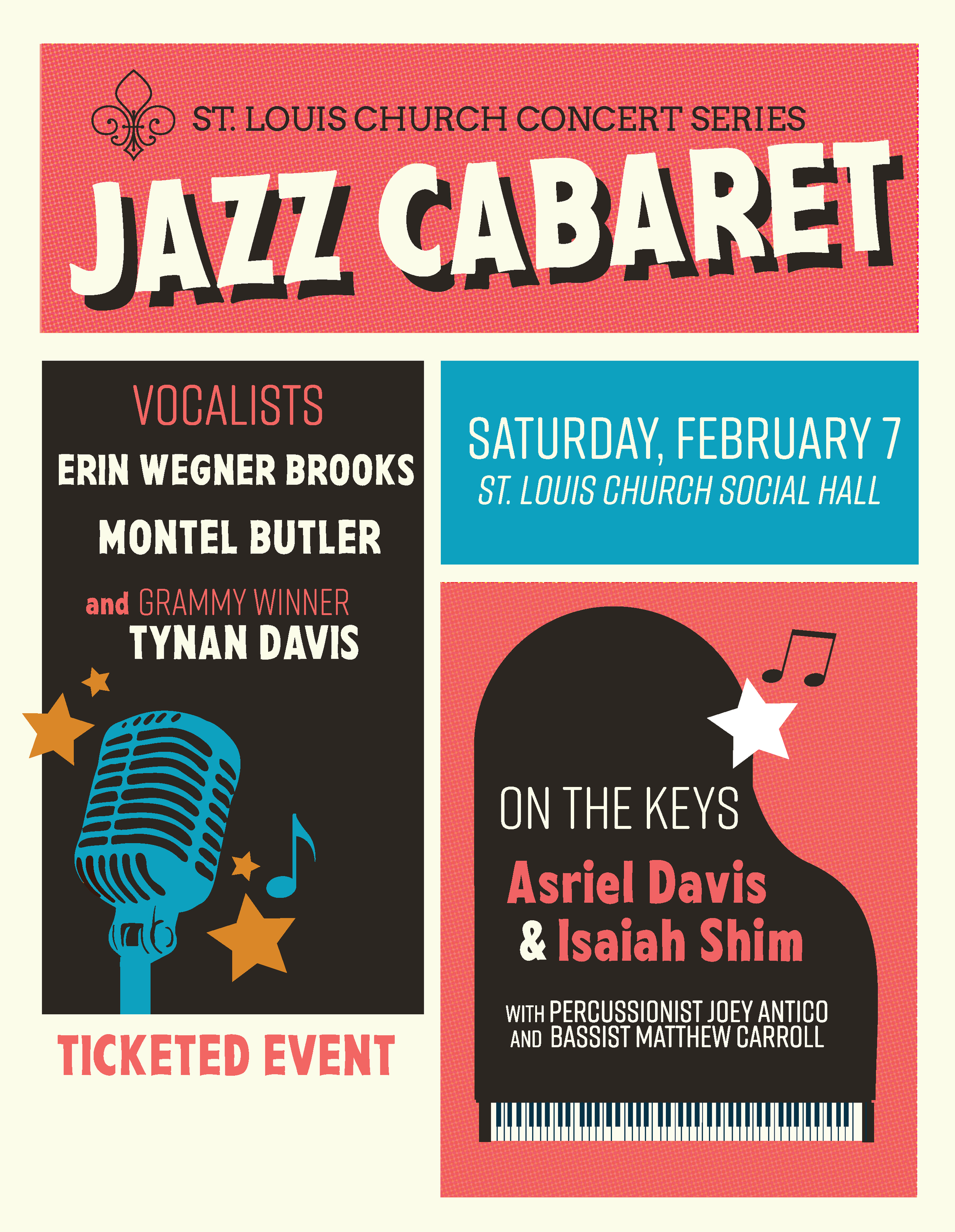
Our popular Jazz Cabaret Series takes on a fresh twist by blending the program’s traditional vocal performances with the thrilling return of last season’s dueling keyboardists. Prepare to be mesmerized as the fingers of Asriel Davis and Isaiah Shim fly over the keys, showcasing exceptional technique and improvisational flair. Fan favorites Erin Wegner Brooks and Montel Butler, alongside Grammy-winning Tynan Davis, join them on stage in a dazzling program that mixes prepared repertoire, on-the-spot improvisation, and even audience requests.
Time & Date: Saturday, February 7, 2025 at 7 p.m.
Location: St. Louis Church Social Hall (12500 Clarksville Pike, Clarksville, MD 21029)
Admission: $30 ticket in advance, $35 at the door
Limited Seating Available; This event is expected to sell out quickly so secure your tickets today!





Christmas Ornaments
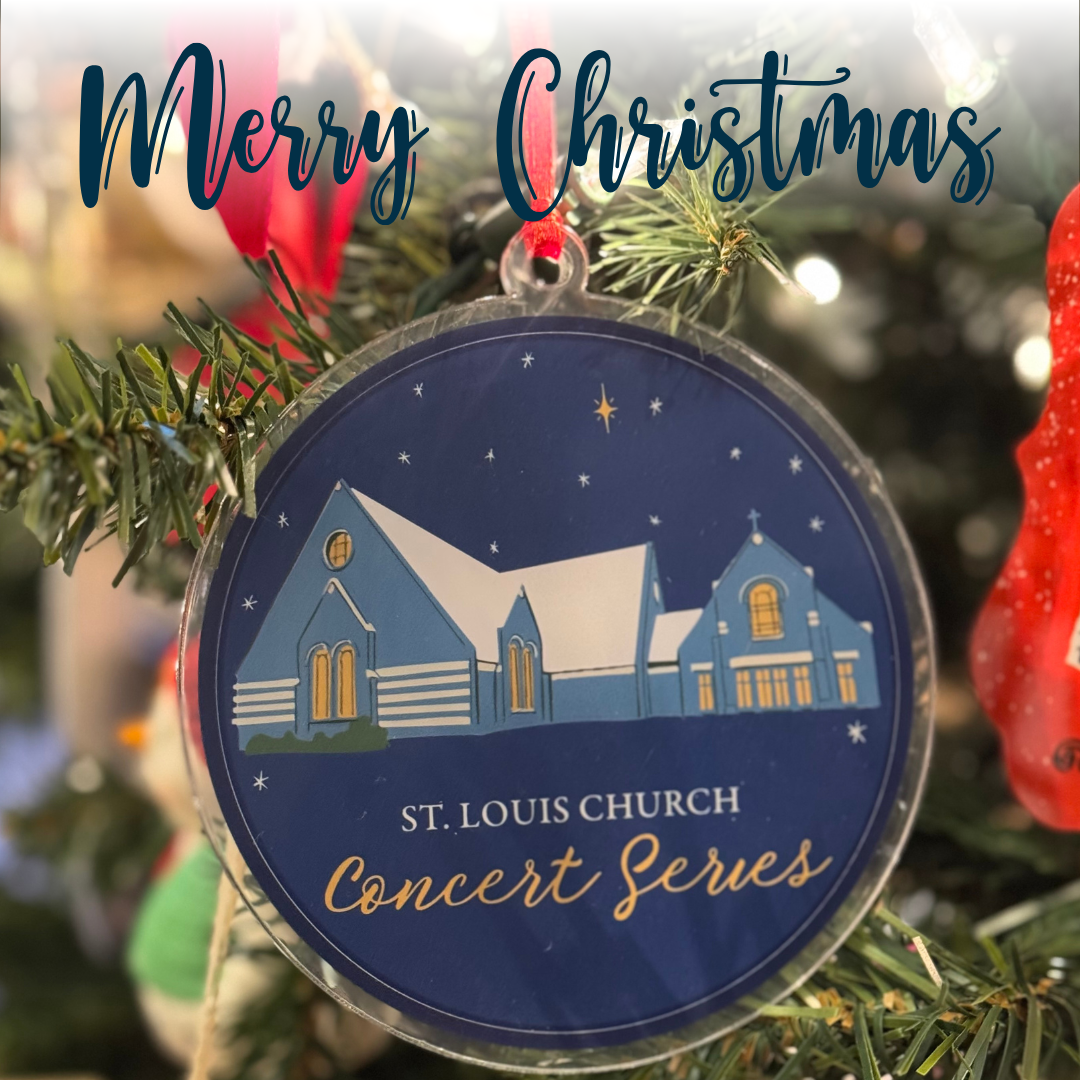
Bring some music to your home this Christmas season!
We’re excited to share a special thank-you with you this year—a beautiful ornament to celebrate the joy of music and community! For a donation of just $25 or more, you can bring home a bit of holiday magic to help deck your halls. Visit our table in the Narthex to donate today!
Please note, this is the same ornament from last season!
Tell Us Why You Love the Concert Series
Whether you’re new to the series or have been with us since our start in 2006, we’d love to hear why you love the Concert Series!
*By submitting this form, you agree that part or all of your message, including your name if submitted, may be used for digital and/or print marketing purposes by the St. Louis Church Concert Series.