
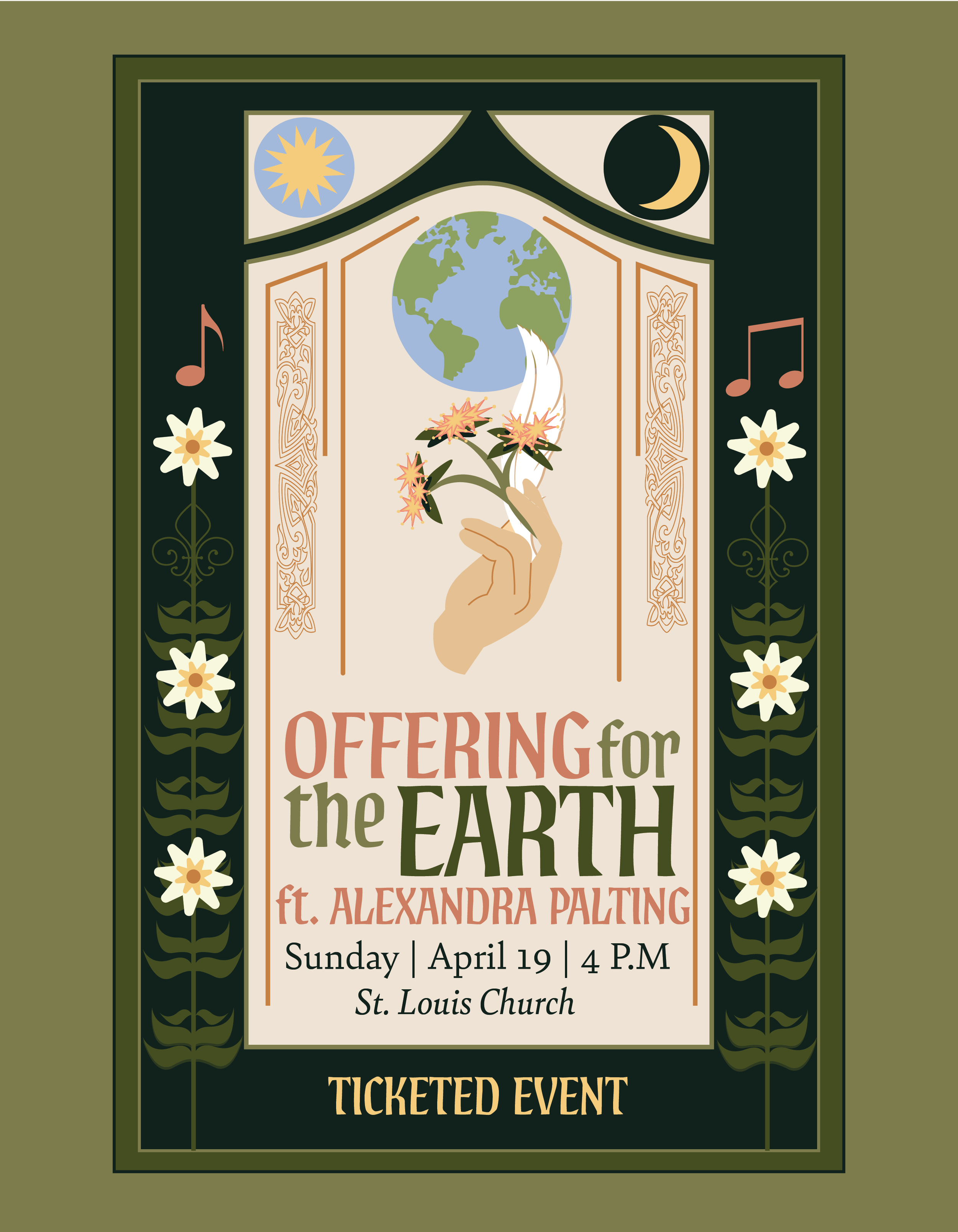
Due to overwhelmingly positive response, this concert will now take place in the Church!
|
Due to overwhelmingly positive response, this concert will now take place in the Church! |
Offering for the Earth
A Biorhythmic Celebration of Hildegard Von Bingen
April 19, 2026 at 4 p.m.
"All of creation is a song of praise to God. If we fall in love with creation deeper and deeper, we will respond to its endangerment with passion." — Saint and Doctor of the Church Hildegard von Bingen
“Offering for the Earth” celebrates and brings to life this timeless wisdom. In this concert, St. Louis parishioner and performing artist Alexandra Palting blends the sacred medieval songs of St. Hildegard Von Bingen with modern electronic music generated from the biorhythms of plants, creating an environment that fuses past and present, technology and music.
In today’s world of information overflow, Hildegard's legacy serves as an enduring example that knowledge and wonder can and should coexist. This concert promises to ignite curiosity about the natural world, inspire trust in the heavenly world to come, and open our hearts toward becoming faithful stewards of Earth that God asks us to be.
Alex will be joined by Isaiah Shim, Laura Hill, and the St. Louis Treble Choir. Fr. DeAscanis and ACTS brother and environmental advocate Jose Aguto, will also offer their wisdom in exploring the intersections of theology, art, and environmental stewardship.
Details
Location: St. Louis Church (12500 Clarksville Pike, Clarksville, MD 21029)
Admission: $25 in advance, $30 at the door.
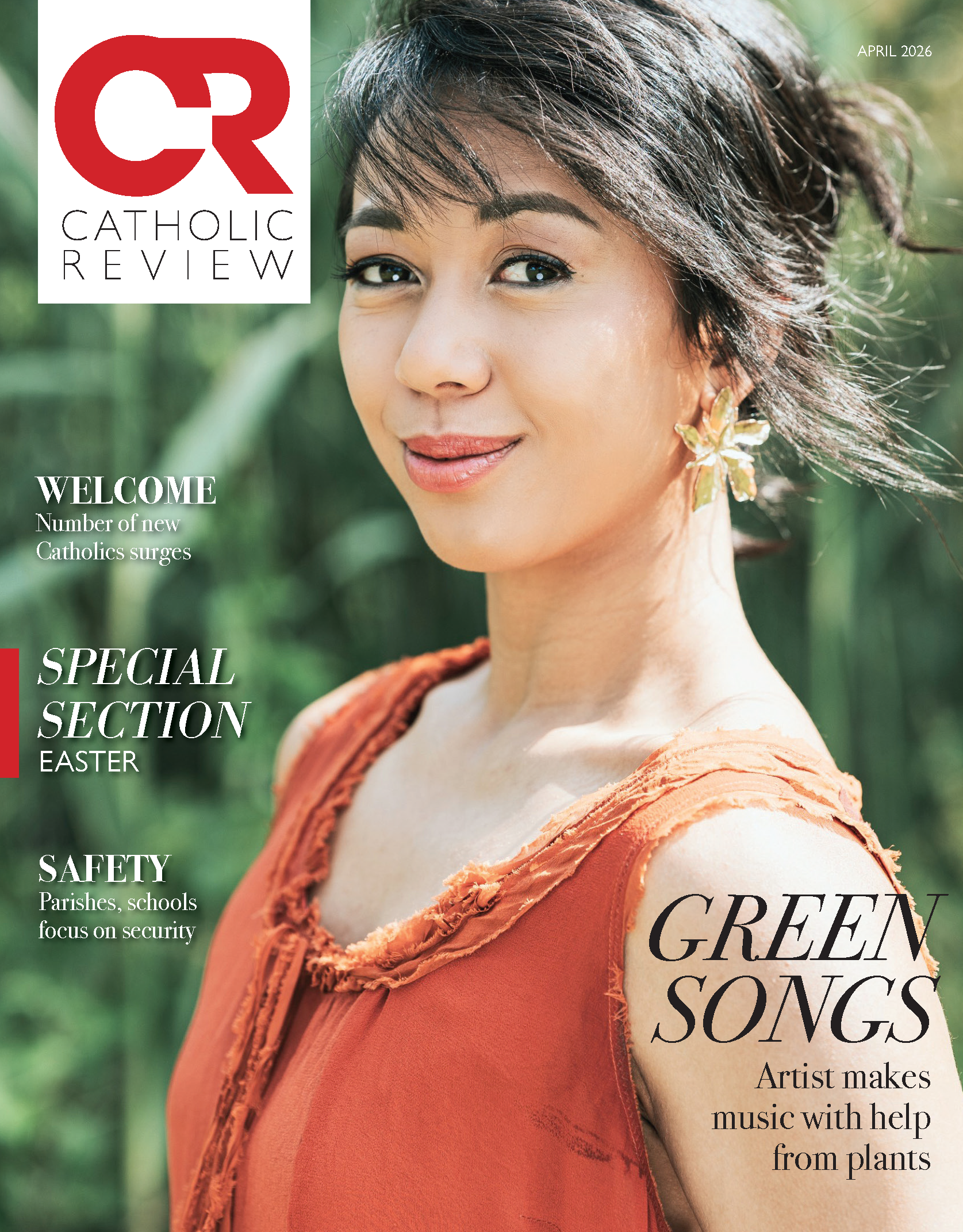
Be sure to read this article, published in the Catholic Review, about our upcoming concert!
Also, listen to this radio interview from the Catholic Review, featuring Alexandra!
Meet The Artists

Alexandra Palting

Isaiah Shim

Laura Hill

Paul Heinemann
-
Alexandra Palting is a performer and award-winning writer based in New York City. Aside from her time as Artist in Residence at The Kennedy Center, other favorite local credits include CATF, Olney Theatre Center, Imagination Stage, Chesapeake Shakespeare Company, and The Keegan Theatre. She is the performer, writer, lyricist and co-composer of 0874: A Filipino-American Love Story, a one-woman musical that was performed locally at The Kennedy Center, off-Broadway at Connelly Theater, and internationally at the U.S. Consulate in China. Most recently, she was a featured soloist on the original off-Broadway cast album Chasing Grace. She has performed her original music at venues including The Lincoln Theatre and Merriweather Post Pavilion and her career as a singer has taken her from the swing clubs of Baltimore to the Vatican. Her most recent on-camera work can be seen on "Law and Order," and her most recent voiceover work can be heard on Audible produced by Macmillan Audio. Alex feels so blessed for any chance she has to return to her Catholic home at St. Louis.
-
Isaiah Shim is a “crossover” pianist/keyboardist whose specialty ranges from classical to jazz, instrumental to vocal, orchestral to choral, and meticulously-practiced masterworks to free-form improvisations. He currently serves as Assistant Conductor of Columbia Pro Cantare and Organist at St Louis Church. He is also an educator teaching in the Howard County Public School System.
He has been involved with a number of organisations in the area, including Annapolis Opera, Baltimore Chamber and Symphony Orchestras, Columbia Orchestra, Maryland Classic Youth Orchestras, Montgomery Philharmonic, National Symphony Orchestra, and Young Artists of America. Outside of the US, he has performed in several countries in Asia, Australia, the Caribbean, and Europe. Artists he had the opportunity to work with include Avi Avital, Kristin Chenoweth, Andrew Lippa, Nicholas McGegan, Stephen Schwartz, Gil Shaham, Christoph Storgårds, among others.
Isaiah Shim received graduate degrees in conducting and collaborative piano from the Peabody Institute of The Johns Hopkins University, where he was mentored by Marin Alsop and Eileen Cornett. Additionally, he received Bachelor of Music degrees in piano performance and music education from Wheaton College in Illinois, where he studied piano with Dr Karin Redekopp Edwards and conducting with Drs Daniel Sommerville and John William Trotter.
-
Laura Hill has over a decade of professional experience in sacred music, performing as both a soloist and choral singer, and serving as a cantor in churches throughout the Archdioceses of Baltimore and Washington. A lifelong member of St. Louis Parish, she regularly sings as a cantor at Sunday Masses and in support of other parish ministries.
She began her college studies in musical theatre at the Catholic University of America before transferring to the University of Maryland, where she pursued another field of study while completing a minor in vocal performance.
When she’s not singing, Laura enjoys spending time with her husband and their two energetic boys. For her, music is both an art form and an expression of faith. She is honored to be a part of the concert series at St. Louis, a place that has played a significant role in both her faith and musical journeys.
-
Paul Heinemann is renowned for his tremendous gift of connecting with middle school adolescents. His energy and enthusiasm have inspired his students to achieve at high levels. He is currently the choral director at Loiederman Middle School, a magnet program for the Performing Arts. His choirs have consistently earned superior ratings at county, state and interstate festivals and competitions and they have performed as a demonstration chorus for multiple MMEA conferences.
Paul has served as a guest clinician and adjudicator for festivals throughout Maryland, as well as a guest conductor for numerous middle school honors choruses, including 9 years as the resident director of the Montgomery County Middle School Honors Chorus. He has presented at local and state conferences multiple times. Additionally, Paul has served as an artistic and music director for theatre programs at both the middle and high school levels and is the Director of the JR (middle school) program for Young Artists of America.
Paul was recognized with the Montgomery County Gazette’s ‘Favorite Teacher’ award in 2011. His choral program was awarded the ‘Program of Excellence’ award from the Maryland Music Educators Association in 2012. Paul was also recognized with the Maryland Music Educators Association ‘Outstanding Music Educator’ Award in 2018.
PlantWave Technology
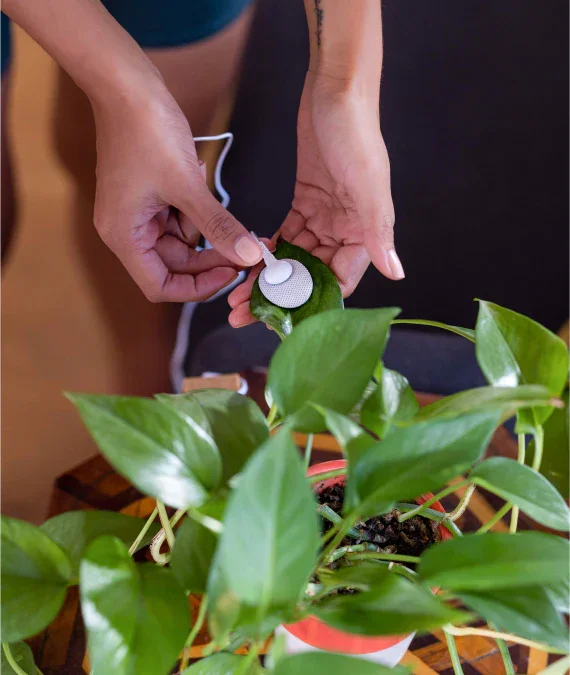
How Does It Work?
What if plants could make their own kind of music? With a device called PlantWave, they can. This technology attaches two small sensors to a plant’s leaves to measure subtle changes in electrical conductivity as the plant responds to light, moisture, touch, and its surrounding environment. Through a process called sonification, PlantWave amplifies these tiny fluctuations, converts them into wave patterns, and then translates them into musical notes and tones. The result is a continuously evolving soundscape shaped by the plant’s biological activity. Introduced less than a decade ago, PlantWave offers a creative way for listeners to connect with the natural world, bringing plants from the backdrop to center stage to create their own distinctive music.
Meet St. Hildegard von Bingen
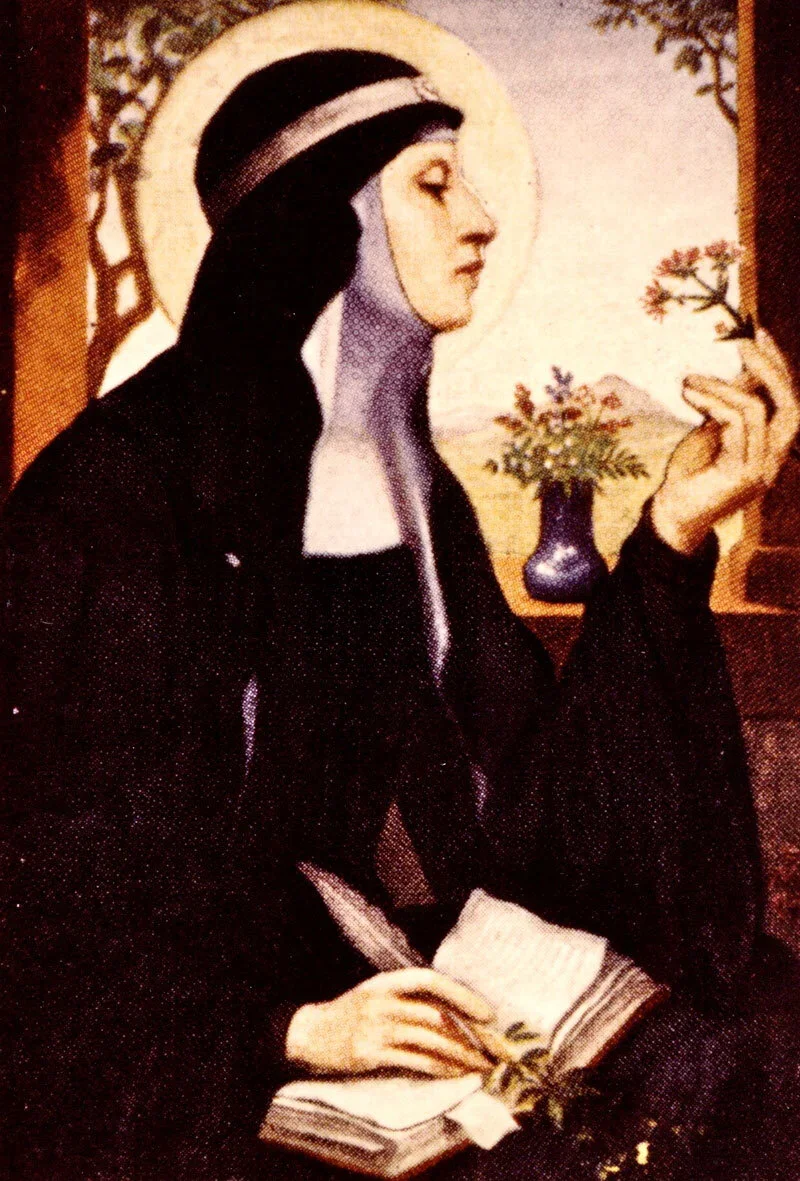
“All living creatures are sparks from the radiation of God’s brilliance, emerging from God like the rays of the sun.” Saint and Doctor of the Church Hildegard von Bingen
Born in 1098, Hildegard of Bingen was one of the most remarkable figures of the Middle Ages—a German Benedictine abbess, visionary mystic, and pioneering composer whose work united music, nature, and spirituality. She composed more than 70 songs, one of the largest surviving bodies of music by any medieval composer. Apart from her musical output, Hildegard authored nine major works on theology, natural science, and medicine, as well as hundreds of letters to emperors, popes, bishops, and fellow religious communities. Through her visions, music, and writings, Hildegard described humanity and the earth as “living sparks” of divine love, profoundly interconnected. Though widely respected in her own lifetime, Hildegard’s music and ideas lay largely dormant for more than 900 years before being rediscovered in the late 20th century. In 2012 Pope Benedict XVI canonized Hildegard and recognized her as a Doctor of the Church, one of only four women in Christian history to receive this honor. Hildegard’s voice speaks as powerfully in the 21st century as it did in the Middle Ages—making her music a fitting celebration of Earth Day and the sacred vitality of the natural world.
Catholic Church Teachings on Environmental Conservation
“If you want to cultivate peace, protect creation.” – Pope Benedict XVI, 2010 Message for the World Day of Peace
Care for creation is a core expression of Catholic faith, rooted in Scripture and shaped by modern teachings. From the opening chapters of Genesis, human beings are called “to cultivate and care for” the garden of Eden (Gen 2:15), while The Psalms remind us that “the earth is the Lord’s and all it holds (Ps 24:1). The Catechism of the Catholic Church teaches that the earth’s resources are entrusted to the common stewardship of humanity and affirms the interdependence of all creatures.
Over the centuries, these biblical and doctrinal foundations have been developed through milestones in modern Catholic teaching, particularly in papal writings and statements from bishops. A major turning point came with Pope John Paul II’s 1990 Message for the World Day of Peace, which identified the ecological crisis as a moral issue and promoted responsible stewardship. In the United States, the statement Renewing the Earth, issued by the U.S. Catholic Conference of Bishops in 1991, affirmed that caring for the environment is a requirement of the Catholic faith. Pope Benedict XVI’s 2009 encyclical Caritas in Veritate (“Charity in Truth”), links environmental responsibility to duties toward the poor and accountability to future generations. Pope Francis made environmental stewardship a cornerstone of his papacy, using his landmark 2015 treatise Laudato Si’ (“Praise Be To You”)—the first papal encyclical focused solely on the environment—to issue a sprawling call to action and to highlight the social and environmental crisis posed by the ecological crisis, in particular, climate change.