
20th Anniversary
Celebration Program
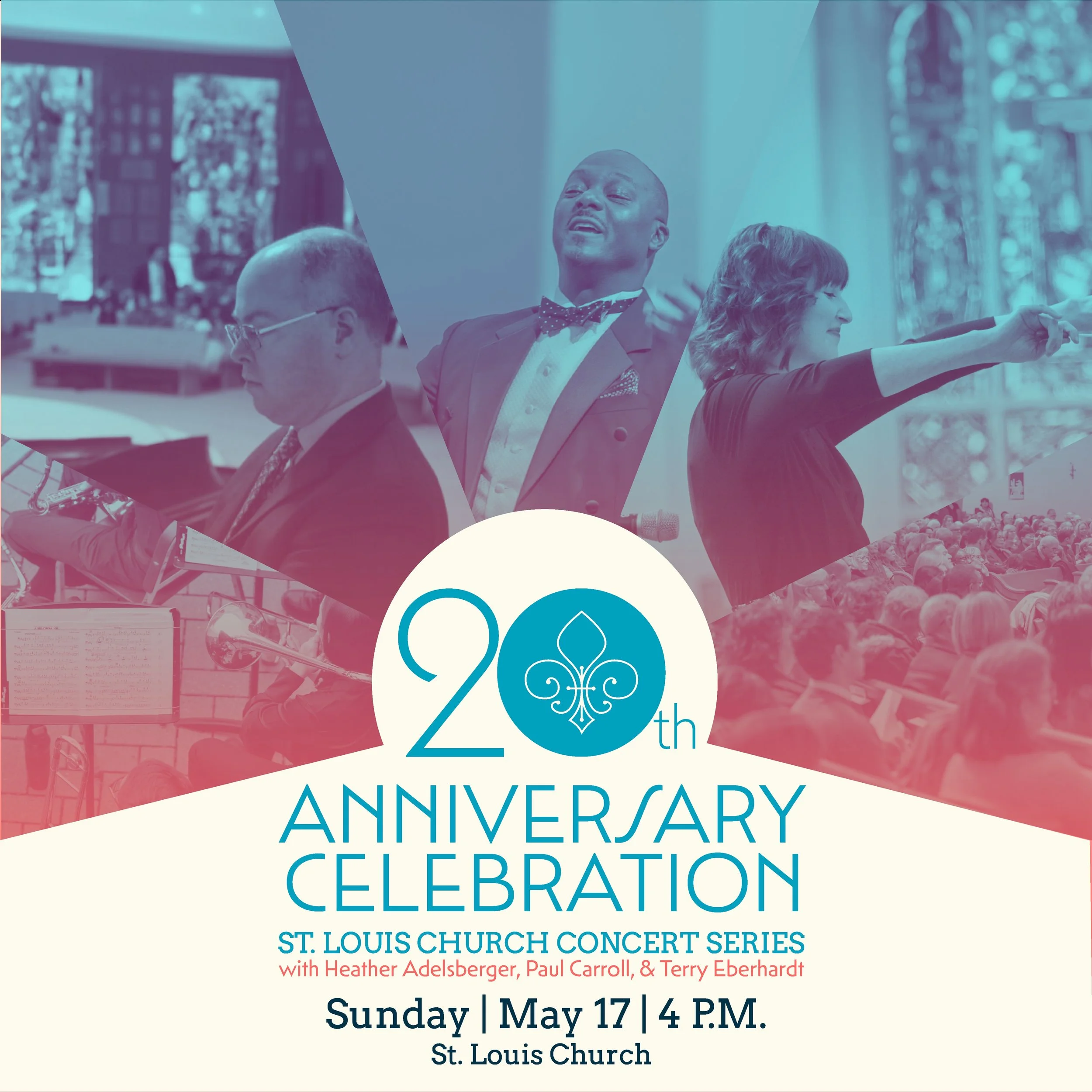
Concert Program
The Orchestra of St. Louis
The St. Louis Concert Chorus
Heather Adelsberger, Paul Carroll, & Terry Eberhardt, conductors
To read the program notes, simply press the + button next to each name.
-
Aaron Copland, composer
John Romano, arranger
Heather Adelsberger, conductorAaron Copland’s “Fanfare for the Common Man” is among the most recognizable ceremonial works in American music. Majestic and bold, it has become one of Coplan’s signature compositions, long associated with unity, resilience, and everyday heroism.
Copland composed “Fanfare” in 1942 in response to a commission from conductor Eugene Goossens of the Cincinnati Symphony Orchestra. Gossens had invited several American composers to write short fanfares—musical “cheers” intended to honor the Allied war effort, celebrate ordinary American citizens and boost morale during World War II. Goossens suggested instrumentation for brass and percussion and a duration of roughly two minutes. Of the commissioned fanfares, only Copland’s achieved lasting fame.
Copland reportedly considered several possible titles, including ideas connected to President Franklin D. Roosevelt’s “Four Freedoms,” before settling on the most universal choice. He was also influenced by Vice President Henry A. Wallace’s phrase “the Century of the Common Man.” Copland’s aim was simple: to pay musical tribute not only to leaders and soldiers, but also to the countless people whose everyday labor sustained wartime life.
Goossens had hoped to premiere the work at the Cincinnati Symphony’s opening concert that season, but Copland did not complete the score until November 1942. The first performance finally took place on March 12, 1943, with Goossens conducting.
Copland later incorporated “Fanfare” into the finale of his Third Symphony (1946), further securing its place in the American orchestral repertoire. Over the decades, the piece has come to symbolize heroism, unity, and collective effort, appearing at political events, athletic competitions, and memorial observances. Copland’s masterpiece has also inspired adaptations across genres, from jazz interpretations by clarinetist Woody Herman to rock renditions by the Rolling Stones and Styx.
*previously planned for performance at Spring at St. Louis: Sounds of the American West (March 22, 2020) - Cancelled due to COVID
-
Aaron Copland, composer
Mack Wilberg, arranger
Heather Adelsberger, conductorDenis Karp, flute
Charlene Romano, piccolo
Charles Higgs, organ'Tis the gift to be simple, 'tis the gift to be free.
'Tis the gift to come down where we ought to be.
The words and melody to “Simple Gifts” are now familiar, thanks largely to Aaron Copland’s set of variations on the Shaker song in Appalachian Spring. Originally written in 1848 by Elder Joseph Brackett, “Simple Gifts” was largely unknown outside Shaker communities until Copland used it nearly 100 years later; first in the ballet score, and shortly thereafter, in the orchestral suite.
Copland began work on Appalachian Spring in 1943, after receiving a commission from the Elizabeth Sprague Coolidge Foundation to create a ballet for Martha Graham to perform at the Library of Congress. The ballet premiered in October 1944, achieving immediate success and earning several prestigious awards. The Suite for Orchestra was first performed the following year with the New York Philharmonic.
Copland initially delivered the score under the working title Ballet for Martha, which later became the work’s subtitle. Graham suggested the title Appalachian Spring, taking inspiration from a poem by Hart Crane. (Despite the name, the work does not depict the Appalachian region or the season; “spring” refers to a water source.)
Appalachian Spring has become Copland’s most loved and enduring work. Though he neither wrote the text nor composed the melody of “Simple Gifts,” the song is now indelibly linked to his name.
Extra Credit Reading: Copland returned to “Simple Gifts” in 1950 in his first set of Old American Songs for voice and piano (later orchestrated). He drew on America’s folk-music traditions for “Simple Gifts” and the other four songs in the set.
*previously planned for performance at Spring at St. Louis: Sounds of the American West (March 22, 2020) - Cancelled due to COVID
-
Leonard Bernstein, composer
Stephen Schwartz, lyricsChris Rhodovi, soloist
Charles Higgs, organ*previously performed at Concert Series inaugural concert (May 7, 2006)
-
James Erb, arranger
Paul Carroll, conductorFew American folk songs have traveled as far—or changed as much along the way—as “Shenandoah.” Known by many titles and sung in countless variants, it tells the story of a fur trader in love with the daughter of a Native American chief, most often identified as the Oneida Iroquois chief Shenandoah.
Like much traditional music, the song’s beginnings are difficult to pin down. References to “Shenandoah” date to the early 19th century, and scholars have proposed several paths by which it entered oral tradition. One theory connects it to French Canadian voyageurs (fur traders), who sang to pace the steady work of paddling and to pass time while journeying inland waterways, including the Missouri River. Another theory places the song among loggers. By the late 1800s, “Shenandoah” was also documented as a sailor’s work song or sea shanty, accompanying labor aboard the ships. Some researchers further point to African-American roots or influence, citing accounts of Black dockworkers singing while loading and unloading cargo in late 19th-century ports.
The song’s modern popularity surged during the folk revival of the 1950s and 1960s, when it became a staple for singers such as Pete Seeger and Arlo Guthrie. Since then, “Shenandoah” has appeared in film and television and has become a favorite for choirs and instrumentalists alike. Heard today, this enduring tune serves as a reminder of how American musical traditions are shaped over time and across distance by many communities, traditions, and voices.
*previously performed at Songs from Sea to Shining Sea: A Musical Salute to Veterans (June 11, 2023)
-
Margaret Bonds, arranger
James F. Dausch, orchestration
Terry Eberhardt, conductorKarla Rivera Curtis, soloist
Our 20th anniversary program celebrates giants of the American musical canon—Aaron Copland, Leonard Bernstein, and George Gershwin. Alongside these masters, it also draws attention to the works of a lesser-known, but no less towering figure: Margaret Bonds (1913-1972). Bonds was not only a gifted musician, but also a passionate champion of Black culture and tireless advocate of racial and social justice.
Raised in Chicago, Margaret Bonds was a trailblazing composer, concert pianist, music educator, and church musician. Her work draws deeply on African-American spirituals and Black musical traditions, integrated with Western classical forms. In 1933, she made history as the first Black soloist to perform with a major American orchestra, appearing with the Chicago Symphony Orchestra.
A central influence in Bonds’s career was her lifelong friendship and collaboration with poet Langston Hughes. Their partnership produced some of Bonds’s most enduring works, including song cycles, theatrical scores, and the Christmas cantata The Ballad of the Brown King, which retells the story of the Magi through the perspective of Balthazar.
Throughout her life, Bonds used her influence to advance the work Black composers, poets, and performers. She founded the Margaret Bonds Chamber Music Society, whose mission was to establish a canon of music by African-American composers. Her work at New York City’s East Side House Settlement, a nonprofit for underprivileged youth, brought music education and performances to underserved communities. In Los Angeles during her final years, Bonds was actively involved with the Inner City Cultural Center.
Margaret Bonds died in 1972 at the age of 59, leaving behind an output of more than 200 compositions, many of which were lost, dispersed, or unpublished. Nonetheless, the works that survive—fewer than half—testify to Bonds’s enduring impact on American music.
“He’s Got the Whole World in His Hands,” arranged in 1963, remains one of Bonds’s most beloved settings. Written for her close friend, soprano Leontyne Price (now 99 and living in Howard County), this arrangement of the traditional spiritual conveys a message that is both simple and universal: all of creation rests within divine care.
*The orchestral version heard today was created for the Concert Series’ 2017–18 season opener, My Favorite Things, and premiered by Grammy-winning soprano Jessica Rivera.
-
George Gershwin, composer
John Romano, arranger
Paul Carroll, conductorfeaturing Atlantic Reed Consort
Eddie Sanders, bassoon
Brooke Emery, clarinet
Joey Valez, bass clarinet
Emily Snyder, oboe
Jeremy Koch, saxophoneVibrant, lyrical, and unmistakably American, George Gershwin’s “Rhapsody in Blue” remains one of the defining works of the 20th century—a groundbreaking fusion of classical music and jazz. A favorite at the Concert Series, this cultural icon returns for our 20th anniversary celebration, performed by the Atlantic Reed Consort and the Orchestra of St. Louis.
Premiere (1924). With Gershwin himself at the piano, “Rhapsody in Blue” premiered on February 12, 1924, at New York City’s Aeolian Hall. Jazz bandleader Paul Whiteman had organized the concert, billed as an “Experiment in Modern Music,” to demonstrate that jazz—still a relatively new musical language—could be appreciated as a sophisticated art form. The response was electric. The work quickly became a landmark in American music, opening new doors not only for Gershwin but for a distinctly American concert voice.
The backstory. In late 1923, Whiteman invited Gershwin to compose a new work for his orchestra, but the busy Broadway composer declined. To Gershwin’s surprise, a January 4, 1924 New York Tribune article announced he was already “at work on a jazz concerto.” With the concert fast approaching, Gershwin committed to the project. Whiteman also offered the services of Ferde Grofé, the bandleader’s chief arranger. Not only did Grofé bring experience to the project—Gershwin had never written for orchestra—he could also tailor it to the distinctive sound and players of the Whiteman ensemble.
Train to Boston. Gershwin later recalled that inspiration struck while riding a train to Boston—its “steely rhythms” and “rattlety-bang” turning into music in his imagination. “There I suddenly heard—and even saw on paper—the complete construction of the rhapsody, from beginning to end… I heard it as a sort of musical kaleidoscope of America—of our vast melting pot, of our unduplicated national pep, of our metropolitan madness.” By the time he reached Boston, the piece had taken shape in his mind.
“Rhapsody” finds its title. Gershwin composed the work (initially as a two-piano score) in under a month. Grofé then orchestrated it for Whiteman’s orchestra, creating the colorful sound world listeners still associate with the piece. Credit for the title goes to Ira Gershwin, who suggested “Rhapsody in Blue” after seeing the paintings of James McNeill Whistler (whose titles often paired musical terms with colors) at a gallery exhibit.
A room full of musical stars. The premiere of “Rhapsody” attracted an unusually wide audience, including leading figures from the classical world. Among those in attendance were Sergei Rachmaninoff, Leopold Stokowski, Efrem Zimbalist—evidence that Whiteman’s “Experiment” had captured the attention of the musical establishment.
About that opening clarinet solo. The now-iconic opening clarinet glissando was reportedly shaped in rehearsal by Ross Gorman, virtuoso clarinetist in Whiteman’s orchestra. Gorman’s improvisatory embellishment stuck, transforming Gershwin’s written phrase into one of the most recognizable openings in American music.
*first performed at the Dueling Pianos concert on February 22, 2020. Today’s performance is a world premiere arrangement by John Romano.
-
Aaron Copland, composer
Heather Adelsberger, conductor“The Promise of Living” comes from The Tender Land (1954), Aaron Copland’s only full-length opera. Set in the 1930s, the opera portrays the life of a struggling Midwestern farm family and centers on their teenage daughter, Laurie Moss, who finds herself torn between her family’s generations-long farming tradition and the lure of “the world out there.” Closing Act I, “The Promise of Living” serves as a hymn of gratitude—celebrating the land, the strength of community, and the hope bound up in the coming harvest.
Copland and his librettist, Erik Johns (writing under the pseudonym Horace Everett), drew inspiration from Let Us Now Praise Famous Men, the landmark work by James Agee with photographs by Walker Evans. Based on the artists’ 1936 encounters with three Depression-era sharecropper families, the book’s portraits of perseverance deeply informed The Tender Land. Two photographs in particular—one of a middle-aged woman and another of a young girl—inspired the characters of Ma Moss and her daughter Laurie.
Premiered by the New York City Opera on April 1, 1954, The Tender Land was met with a lukewarm reception from both critics and audiences and closed after a short run. Determined to preserve the work, Copland and Johns revised the opera, adding an additional act. The new version was performed at Tanglewood in August 1954 and at Oberlin College in May 1955. In 1958, Copland further ensured the music’s survival by arranging an orchestral suite from the opera’s highlights, bringing the work to a wider audience.
Although the opera itself initially struggled to gain a foothold, “The Promise of Living” has endured as one of Copland’s most beloved choral works.
*A longtime favorite of the Concert Series, it was previously heard in the 2021 spring program “Reflect, Rejoice” honoring Msgr. Luca, and most recently in the 2023 concert “From Sea to Shining Sea: A Musical Salute to Veterans.”
10 MINUTE INTERMISSION
-
George Gershwin, composer
Ira Gershwin, lyricsHeather Adelsberger, piano
Larissa Sanders, piano*previously performed at Mardi Gras concert in 2019
-
George Gershwin, composer
Ira Gershwin, lyrics
James F. Dausch, arranger
Terry Eberhardt, conductorErin Wegner Brooks, soloist
The 1930 Broadway musical Girl Crazy, with music by George Gershwin and lyrics by Ira Gershwin, introduced a remarkable cluster of standards, including “I Got Rhythm” and “Embraceable You.” Before long, these numbers—and others from the score—would take on lives beyond the stage to become fixtures of American music.
Introduced by 23-year-old Ethel Merman, “I Got Rhythm” is among the catchiest and most exuberant melodies in American music. Beyond its simple message of finding richness in life’s essentials, together with its enduring place in the Great American Songbook, the tune helped shape the language of modern jazz. Its familiar 32-bar form (AABA) and lively chord progression became a template for countless improvisations and new melodies, from those by Duke Ellington to Charlie Parker.The arrangement heard in today’s performance is adapted from Rob Fisher’s version, created for the 1996 centenary celebration of Ira Gershwin at Carnegie Hall.
Extra Credit Reading: It took three tries before “I Got Rhythm” got its chance to shine—and a fourth before it reached listeners worldwide. It began life at a slower tempo in the 1928 musical Treasure Girl and, like “Embraceable You,” was slated for the ill-fated, unfinished 1928 show East Is West before being refashioned for Girl Crazy. The song’s big-screen moment came in the 1951 film An American in Paris, with Gene Kelly singing and tap dancing.
*This adaptation was previously featured in our 2010 Spring Concert, performed by Kate Douglass under the baton of Paul Carroll.
-
George Gershwin, composer
Ira Gershwin, lyrics
James F. Dausch, arranger
Terry Eberhardt, conductorJoe Ciani-Dausch, soloist
With its soaring melody and rich lyricism, “Embraceable You” showcases Gershwin’s gift for songs of uncommon warmth and sophistication. The number was introduced in Girl Crazy by the then-unknown 19-year-old Ginger Rogers (alongside actor Allen Kearns) with choreography by Fred Astaire. Like Merman’s “I Got Rhythm,” it helped propel both performer and song to instant popularity. Since then it has attracted artists across genres, from Ella Fitzgerald, Frank Sinatra, and Johnny Mathis to countless instrumentalists. A lyricist’s tour de force, Ira Gershwin’s text unfolds in a cascade of inventive three-, four-, and even five-syllable rhymes.
Nearly a century after their debuts, these songs remain touchstones of American popular music: who could ask for anything more?
Extra Credit Reading: Girl Crazy became legendary not only for what happened onstage, but for the extraordinary talent surrounding it. The show helped launch the careers of Ethel Merman (in her stage debut) and Ginger Rogers. In the pit, opening night featured future jazz legends Glenn Miller, Benny Goodman, Gene Krupa, and Jimmy Dorsey. George Gershwin himself conducted that first performance.
*The song was also featured in our 2010 Spring Concert, performed by Neil Ewachiw under the direction of Paul Carroll.
-
George Gershwin, composer
Ira Gershwin, lyrics
James F. Dausch, arranger
Terry Eberhardt, conductorJoe Ciani-Dausch, soloist
Liz Mulligan, soloistFew songs capture the wit and verbal brilliance of George and Ira Gershwin more than “Let’s Call the Whole Thing Off.” Built around playful contrasts in pronunciation—“you like tomato and I like tomahto”—the song unfolds as a he‑said, she‑said duet that turns linguistic differences into musical delight.
Written for the 1937 film Shall We Dance, the number was famously introduced by Fred Astaire and Ginger Rogers in an iconic roller-skating sequence—an idea inspired by the everyday pastime of skating in Central Park. Though initially hesitant, Astaire ultimately embraced the challenge. The routine proved exceptionally demanding, requiring 32 hours of preparation and four days to film, according to the American Film Institute. The result became one of the most inventive and memorable dance routines in Hollywood musical history.
Shall We Dance was the seventh of ten films starring Astaire and Rogers and the second—and final—Hollywood musical written by the Gershwin brothers. Two months after the film was released, George Gershwin died of a malignant brain tumor at the age of 38.
Blending sophistication, humor, and emotional insight, “Let’s Call the Whole Thing Off” remains a beloved classic of the American songbook that continues to charm audiences.
*The arrangement heard today was performed at the Spring Concert 2010 by Kate Douglass and Neil Ewachiw, under Paul Carroll's baton.
-
Amy Grant, composer
James F. Dausch, arranger
Terry Eberhardt, conductorErin Wegner Brooks, soloist
Joe Ciani-Dausch, backup vocals
Liz Mulligan, backup vocals*World premiere arrangement by James F. Dausch
-
Leonard Bernstein, composer
Stephen Sondheim, lyrics
Sid Ramin, arranger
Irwin Kostal, arranger
James F. Dausch, orchestration
Terry Eberhardt, conductorColleen Daly Eberhardt, soloist
*previously performed at Jazz Cabaret: The Great American Songbook on February 7, 2025. Tonight’s arrangement was orchestrated by James F. Dausch
-
Leonard Bernstein, composer
Alan Jay Lerner, lyrics - “Take Care of This House”
Rob Fisher, choral harmonisation - “My House”
Isaiah Shim, arranger
Terry Eberhardt, conductorLiz Mulligan, soloist
This medley brings together two Leonard Bernstein portraits of “home,” spanning settings from the White House to the Darling family nursery in Peter Pan. It pairs songs from two lesser-known corners of Bernstein’s stage output: a late-career Broadway collaboration and an early theater project. “Take Care of This House” comes from 1600 Pennsylvania Avenue (1976), written with lyricist Alan Jay Lerner, while “My House” originated in Bernstein’s music for the 1950 Broadway Peter Pan—a play with songs (distinct from the later 1954 Mary Martin musical).
1600 Pennsylvania Avenue traces lives within the White House—presidents, first ladies, and Black staff—over the nation’s first century. The show famously closed after just seven performances and would prove to be Bernstein’s final original Broadway score. Still, several numbers outlived the production, most notably “Take Care of This House,” which has since entered the Great American Songbook. In the song, First Lady Abigail Adams asks a servant to safeguard the new presidential residence; the request quickly expands into a metaphor for protecting the ideals of a young nation.
For the 1950 Broadway Peter Pan, Bernstein supplied a small group of songs rather than a full score. Sung by Wendy Darling, “My House” longs for the comfort and safety of home, set against the story’s pull toward adventure.
Extra Credit Reading: Bernstein was so disheartened by the failure of 1600 Pennsylvania Avenue that he declined to authorize an original cast recording. After his death in 1990, his estate revisited the show’s many revisions and approved A White House Cantata, a concert version assembled from the original score.
-
Leonard Bernstein, composer
Richard Wilbur, lyrics
Terry Eberhardt, conductorJoe Ciani-Dausch, soloist
Colleen Daly Eberhardt, soloistFew musical finales are as uplifting as “Make Our Garden Grow,” the radiant chorus that brings Leonard Bernstein’s operetta Candide to its close. Having endured the world’s cruelties and absurdities, Candide at last releases his unshakable optimism and embraces a deeper wisdom: meaning is found not in chasing perfection, but in building a better future through love, labor, and shared purpose. Joined by the full company, he resolves to “make our garden grow.” The song has since become one of Bernstein’s most moving and beloved.
Based on Voltaire’s 18th-century satire, Candide premiered on Broadway in 1956 with a libretto primarily by Lillian Hellman and lyrics written chiefly by poet Richard Wilbur (along with contributions from several other writers). The title character clings to the belief that he lives in “the best of all possible worlds,” a philosophy tested by the disasters and disappointments he confronts during his globe-trotting adventures. By the end of his journey, Candide realizes that happiness lies in a simple life—ordinary pleasures, meaningful work—and by tending these with care.
The work resonates especially with this year’s anniversary celebration, as our own “garden” has been cultivated over two decades through artistry, generosity, the dedicated service of volunteers, outreach, and the faithful support of parishioners and the wider community. “Make Our Garden Grow” also holds a special place in Concert Series history. The work was featured in our 2012 Spring Concert, “Mostly Mozart and a Little Bernstein,” conducted by Paul Carroll, and returned in April 2021 for our “Reflect, Rejoice” program, which paid tribute to Monsignor Luca with lyrics adapted to honor his role in helping the spiritual and musical life of St. Louis flourish. Revisiting the song now offers another opportunity to reflect, rejoice, and remember the pastor who helped launch the Concert Series and whose encouragement nurtured its growth.
Finally, “Make Our Garden Grow” reminds us that cultivating “gardens” is a shared endeavor—shaped by vision, creativity, hard work, and the talents of many. In that spirit, the Concert Series continues its mission to Enliven, Educate, and Entertain. Season after season, performers, patrons, staff, and neighbors have tended this garden together—and, with deepest gratitude, we look forward to its continued growth.
Extra Credit Reading: Lyricist Richard Wilbur—twice awarded the Pulitzer Prize and later named U.S. Poet Laureate—brought extraordinary literary elegance to Candide. His text for “Make Our Garden Grow” distills the operetta’s philosophical heart into language at once simple and profound. Bernstein himself considered Candide’s finale among his most meaningful creations, and it has long been performed beyond the stage as a standalone concert anthem of hope and renewal.
Extra Credit Reading: Candide was far too literary and scenically ambitious for the 1950s Broadway stage. The original production was not a success; it ran only 73 nights before being pulled by its producer. In his December 3, 1956 New York Times review, critic Brooks Atkinson wrote: “Let’s admit that the 18th century philosophical tale is not ideal material for a theatre show, for it is plotless and repetitious,” although he did praise Bernstein for composing a “wonderful score all the way through.” Despite the disappointment of the 1956 Broadway production, a cast album was produced and sold well, keeping Candide alive. In the decades since, Candide has seen numerous revisions for performances on musical theater, concert, and opera stages.
*The work was featured in our 2012 Spring Concert, “Mostly Mozart and a Little Bernstein,” conducted by Paul Carroll, and returned in April 2021 for our “Reflect, Rejoice” program, which paid tribute to Monsignor Luca with lyrics adapted to honor his role in helping the spiritual and musical life of St. Louis flourish.
Stay in touch with us!
Concert Series History

Save Our Dates!
While our 20th season may be coming to a close, we look forward to welcoming you back for Season 21 in the fall! Be sure to mark these dates on your calendar, and sign up for our email list to stay in touch as we release more details!
Concert by Candlelight
Friday, October 2, 2026
7 PM | St. Louis Chapel
ticketed
Christmas at St. Louis
Sunday, December 6, 2026
4 PM | St. Louis Church
free admission
Jazz Cabaret
Saturday, February 6, 2027
7 PM | St. Louis Social Hall
ticketed
Spring Concert
Sunday, May 16, 2027
4 PM | St. Louis Church
free admission
Tell Us Why You Love the Concert Series
Whether you’re new to the series or have been with us since our start in 2006, we’d love to hear why you love the Concert Series!
*By submitting this form, you agree that part or all of your message, including your name if submitted, may be used for digital and/or print marketing purposes by the St. Louis Church Concert Series.